
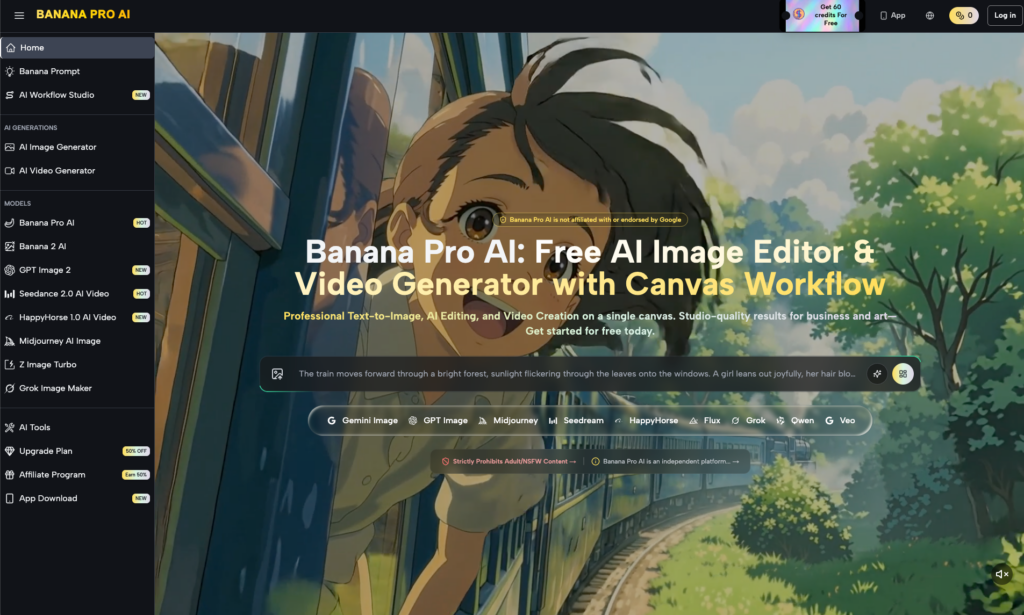
The novelty of generating a single, high-fidelity image from a text prompt has largely worn off for professional creators. We are no longer in the “look what this can do” phase of generative media; we are in the “how do I ship this by Friday” phase. For marketers and creative leads, the primary hurdle isn’t the quality of a single output—it is the lack of repeatability. When you need to scale a concept across twenty different ad sets, three social channels, and a hero video, the “slot machine” approach to prompting falls apart.
The industry is currently grappling with the “one-off” problem. You might land a perfect character or environment render using a high-end model, but as soon as you try to extend that visual language into motion or a secondary set of assets, the aesthetic begins to drift. Colors shift, facial features morph, and the brand identity loses its tether. Building a sustainable production pipeline requires moving away from isolated experiments and toward a centralized environment where tools like Nano Banana and the wider ecosystem provide a framework for consistency.
The Generative Bottleneck: Why One-Off Prompts Fail Creators
The bottleneck in most modern workflows is randomness. Most creators treat AI as a vending machine: insert prompt, receive asset. If the asset isn’t right, they pull the lever again. This is manageable for a single Instagram post, but it is catastrophic for a multi-channel campaign. The moment a creative director asks for a “slight adjustment” to a generated character, the workflow usually breaks because the underlying model lacks a memory of the specific seeds or parameters used in the initial success.
This leads to stylistic drift—a phenomenon where the visual DNA of a project degrades as more assets are produced. One image looks like cinematic 35mm film, while the next leans toward a digital 3D render. For a brand, this inconsistency signals a lack of professional polish. The goal for any serious operator is to find a way to lock in the “look” at the beginning of the process and carry it through every subsequent stage of production.
Furthermore, there is the issue of compute efficiency. Running high-density models for every single iteration is a waste of resources and time. Professionals need a way to sketch and storyboard at high speeds before committing to the heavy lifting of high-resolution video or final-pass renders. This is where the distinction between a “prompt” and a “workflow” becomes critical.
Architecting the Stack: Centralizing Workflows in Banana AI
Professional content creation requires a centralized hub to minimize the friction of switching between different specialized models. Using Banana AI allows a team to keep their assets within a single environment where the output of one model—such as a static landscape from Gemini 3 Pro—can be immediately ported into a video generation engine. This centralization reduces the metadata loss that happens when you are constantly downloading and re-uploading files across disparate web apps.
Within this ecosystem, Nano Banana serves as the high-speed iteration layer. Think of it as the digital equivalent of a thumbnail sketch. Instead of waiting for a full-scale render to see if a composition works, an operator can use Nano Banana to rapidly test lighting, framing, and color palettes. If the “sketch” holds up, it provides a blueprint for the higher-fidelity models to follow. This “low-fidelity first” approach is a staple in traditional animation and VFX, and it is finally becoming a viable strategy in generative media.
The Workflow Studio within the platform further reinforces this by providing a workspace that bridges the gap between static assets and video. By moving away from a single text box and toward a tool-based interface, creators can treat the AI as a collaborator rather than a black box. This structural shift allows for a more granular control over the production pipeline, ensuring that the “big idea” isn’t lost during the transition from ideation to execution.
The Image-to-Video Leap: Establishing Visual Continuity
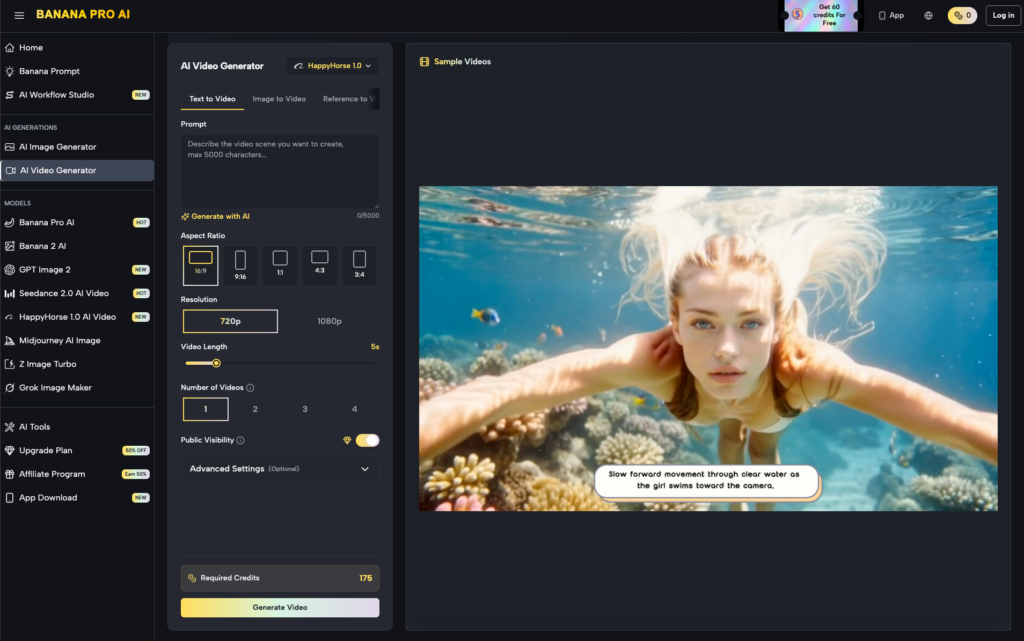
The most difficult transition in any AI-driven workflow is the jump from a static image to a five-second video clip. This is where most projects fail. If you generate a hero image in GPT Image 2 or Gemini 3 Pro, the challenge is ensuring that Seedance 2.0 or HappyHorse 1.0 understands the specific textures and lighting of that source image.
To maintain continuity, experienced operators often use the “image-to-video” path rather than relying on a new text prompt for the video stage. By feeding a high-fidelity image into Seedance 2.0, the AI has a visual anchor. However, even with these tools, we must acknowledge a current limitation: visual “hallucinations” are still common in complex movements. For example, if a character is holding an object, the AI may struggle to maintain the physical integrity of that object as the character moves. It is vital to expect some level of manual trial and error here; we cannot yet guarantee 100% physical accuracy in generative video without multiple takes.
Choosing between models like Seedance 2.0 and HappyHorse 1.0 also requires practical judgment. Seedance tends to excel at visualizing more abstract ideas and fluid motions, while other models might be better suited for rigid object movements. A repeatable workflow involves knowing which engine to use for which specific asset requirement, rather than trying to force a single model to do everything.
Precision Control: Leveraging the AI Image Editor for Final Delivery
No AI model produces a perfect, production-ready asset on the first try every time. Usually, the generation phase only gets you about 80% of the way there. The remaining 20%—the “last mile”—is where professional standards are met or missed. This is where a dedicated AI Image Editor becomes indispensable.
Common generative artifacts, such as warped background details, slightly off-model facial features, or inconsistent lighting, can be addressed through targeted editing rather than rerolling the entire prompt. Using an AI Photo Editor to perform “inpainting” or localized corrections allows a creator to keep the parts of the image that work while fixing the parts that don’t. This is a massive time-saver compared to the “brute force” method of re-generating an image fifty times in hopes of a perfect result.
Moreover, brand safety often requires a level of precision that raw generation cannot provide. If a brand has a specific “no-go” zone for certain visual elements, manual intervention in the editing stage is the only way to ensure compliance. Balancing automated enhancements with this manual oversight ensures that the final output doesn’t just look good, but also aligns with the strategic goals of the project.
Navigating Technical Drift: What We Still Can’t Safely Automate
While the tools in the Banana AI suite are powerful, a grounded approach requires recognizing where the technology currently plateaus. One major area of uncertainty is high-stakes typography. While models are getting better at rendering text, we cannot yet conclude that any AI can handle complex, brand-accurate typography in a single pass without human checks. If your campaign relies on specific font weights or kerning, you will still need to handle that in post-production.
Another limitation involves complex physics in video. While Seedance 2.0 is a significant step forward, simulating realistic liquid dynamics or intricate human-object interactions remains hit-or-miss. As operators, we have to be prepared for the “AI look” to occasionally break the immersion. This is why a “human-in-the-loop” philosophy is mandatory for high-stakes marketing assets. The AI is the engine, but the human is the brakes and the steering wheel.
By accepting these limitations, creators can build workflows that account for them. Instead of trying to automate 100% of the process, focus on automating the 80% that is repetitive and labor-intensive, leaving the final 20% for human refinement. This hybrid approach—using Nano Banana for speed, specialized models for fidelity, and a robust editing suite for precision—is the only way to move from “playing with AI” to “producing with AI” at a professional scale. For those building repeatable pipelines, the goal isn’t to find the magic prompt; it’s to build the best factory.